
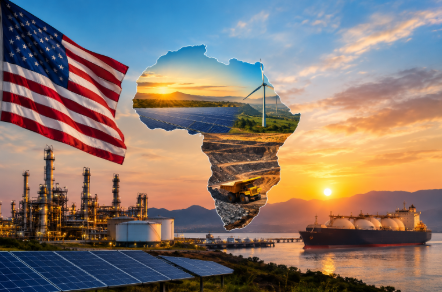
The New U.S.–Africa Energy Equation
Africa’s growing importance in global energy and critical-mineral supply chains is reshaping its relationship with the United States, with investment, infrastructure and energy security increasingly taking centre stage.
The shift reflects a broader change in Washington’s approach to Africa. Energy policy and national security are becoming increasingly intertwined, while critical minerals such as copper, cobalt, lithium, graphite, manganese and rare earths are being treated as strategic assets rather than simply commodities.
For African countries, the changing landscape presents an opportunity to attract capital into energy, mining, infrastructure and industrial development. But securing investment will require more than resource endowments. Bankable projects, predictable regulation, credible counterparties and infrastructure capable of connecting resources to markets remain critical constraints.
“Investors can deal with difficult conditions. What is much harder to deal with is uncertainty,” says Jude Kearney, a veteran international lawyer and senior figure at ASAFO & CO.
Power is particularly significant. Reliable electricity underpins mining, manufacturing, agriculture, transport and digital infrastructure, while gas and LNG can support both export revenues and domestic industrialisation. At the same time, critical minerals are drawing increased attention as governments and companies seek to diversify supply chains.
Infrastructure will determine whether these opportunities can be converted into commercially viable projects. The Lobito Corridor illustrates the emerging model, linking mineral production with transport infrastructure, investment, processing and access to international markets.
Yet African governments are increasingly seeking to move beyond the traditional resource-export model. Local processing, skills development, technology transfer and domestic participation are becoming central to negotiations, particularly as competition for strategic minerals intensifies.
The challenge will be balancing these ambitions with investor requirements. Aggressive local-content or beneficiation requirements can undermine project economics if poorly designed. A more effective approach may combine incentives for processing and infrastructure with progressive requirements for local value creation.
For the US, competition is intensifying. China has demonstrated its ability to connect infrastructure and financing, while Gulf investors are increasingly combining significant capital with rapid decision-making. American companies retain advantages in technology, capital markets and financial expertise, but faster execution will be essential.
Ultimately, the emerging U.S.–Africa energy relationship will depend on whether strategic interests can be aligned with Africa’s development priorities. As Kearney puts it, “the most successful partnerships are those in which everyone can identify a legitimate interest of their own in the success of the transaction.”
The opportunity is therefore not simply to secure resources, but to build the infrastructure, industrial capacity and investment partnerships needed to create lasting economic value on the continent.