
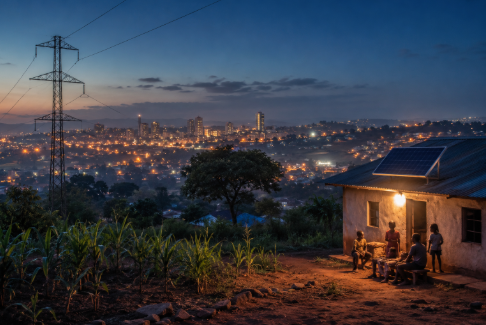
Sub-Saharan Africa Accounts for 86% of the Global Electricity Access Deficit as Rural Progress Falters
Sub-Saharan Africa now represents 86% of the global electricity access deficit, according to the Tracking SDG 7: The Energy Progress Report 2026, highlighting the growing concentration of energy poverty within the region despite decades of investment and international electrification initiatives.
The report, published by leading international energy and development institutions, shows that while global electricity access has risen to approximately 92%, progress across much of Sub-Saharan Africa has remained slow and uneven. The region’s share of the global electricity access gap has increased sharply from 49% in 2010, underscoring the scale of the challenge facing African policymakers, utilities and development financiers.
Between 2010 and 2024, the number of people without electricity access in Sub-Saharan Africa declined only marginally, from 565 million to 563 million. In contrast, other developing regions achieved significant improvements, effectively concentrating the remaining global electrification challenge within Africa.
Nigeria, the Democratic Republic of the Congo and Ethiopia account for nearly one-third of the world’s electricity access deficit. Nigeria alone has an estimated 87 million people without electricity, while the Democratic Republic of the Congo and Ethiopia account for approximately 85 million and 57 million, respectively. Overall, 18 of the world’s 20 largest electricity access deficits are located in Sub-Saharan Africa.
The report identifies rapid population growth, urbanisation and industrial expansion as key drivers of rising electricity demand across the continent. However, it argues that Africa’s electrification challenge is increasingly defined by transmission and distribution constraints, financing gaps and affordability issues rather than generation capacity alone.
One of the report’s most concerning findings is the deterioration of rural electrification outcomes. Sub-Saharan Africa remains the only region globally where the rural electricity deficit has increased over the past decade, with the number of rural residents lacking access rising from 376 million in 2010 to 447 million in 2024. While urban centres have benefited from grid expansion, remote communities continue to face high connection costs and limited infrastructure investment.
The report warns that achieving universal electricity access by 2030 will require countries to more than triple current rates of progress. Meeting this target will demand tens of billions of dollars in annual investment, with blended finance models expected to play a critical role in mobilising both public and private capital.
The study also highlights the growing importance of off-grid and mini-grid solutions, particularly solar and battery technologies, alongside innovative financing models such as Pay-As-You-Go systems. Initiatives such as Mission 300 are expected to accelerate electrification efforts, but experts caution that success will ultimately depend on delivering electricity that is not only accessible, but also reliable, affordable and sustainable.