
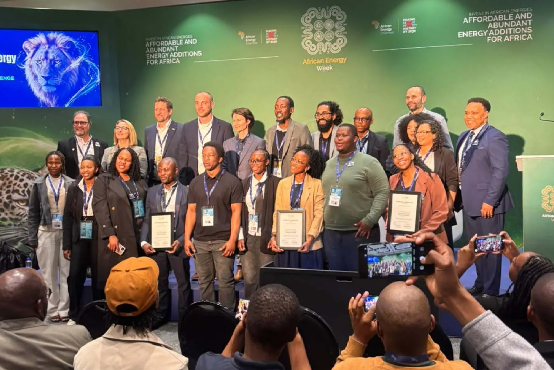
Student Challenge Puts Practical Solutions to South Africa’s Power Crisis in Focus
The African Energy Week (AEW) 2026 Future Leaders Student Challenge has highlighted emerging approaches to South Africa’s electricity challenges, with proposals spanning carbon tax reform, solar-powered water systems, and safeguards for retiring coal-fired power stations.
Team Cobalt took first place with a proposal to redirect existing carbon-tax revenues towards electricity access for low-income households and additional generation capacity, without introducing a new tax. The team recommended establishing a legally capped fund worth R6.2 billion annually from April 2028. Of this amount, R1.86 billion would support households, while R4.34 billion would finance new electricity supply. The proposed allocation represents approximately 1.75% of Eskom’s revenue.
Team Rubidium secured second place with Kgalagadi Axua Intelligence (KAI), an initiative combining solar technology, financing solutions and smart water management for farmers. Targeting challenges in the Northern Cape, the proposal addresses unreliable water access linked to fuel shortages and potential El Niño-related weather disruptions.
Third-placed Team Chromium focused on the planned retirement of Camden Power Station, previously scheduled for closure in 2030. Its proposal established five conditions for retiring generating units: financial close for replacement projects, replacement of metered output, reliable supply, network readiness and consideration of local communities affected by the transition.
The competition was organised by the African Energy Chamber in collaboration with the University of Cape Town (UCT), Stellenbosch University, the University of the Western Cape, Cape Peninsula University of Technology and the University of Pretoria. Up to 150 students participated, developing proposals addressing challenges affecting electricity consumers, businesses and public institutions.
Projects were assessed on their potential beneficiaries, financing requirements, implementation pathways and measurable outcomes. Solutions ranged from technical innovations to policy interventions and new business models, reflecting the need for coordinated approaches to electricity affordability, infrastructure investment and energy security.
The judging panel brought together expertise in engineering, energy law, renewable energy integration, business development and resource governance. Its members included UCT energy law researcher Dr Lindsay Taylah Moses and Stellenbosch electrical engineering lecturer Dr Armand du Plessis.
By connecting university research with AEW’s industry platform, the challenge provided emerging professionals with an opportunity to present solutions to real-world energy problems and engage with industry decision-makers. The initiative also underscored the importance of developing local talent as South Africa balances electricity affordability, generation expansion and the transition towards a more reliable power system.