
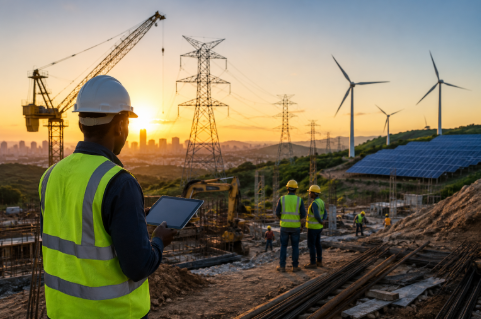
South Africa’s Energy Transition is Reshaping Construction and Exposing a Skills Gap
South Africa’s shift towards a lower-carbon energy system is transforming the construction sector into a critical enabler of energy infrastructure delivery. As grid expansion accelerates and renewable energy capacity grows, contractors are increasingly operating within Engineering, Procurement and Construction (EPC) frameworks that are central to national energy security.
The sector is no longer confined to traditional civil works. It now plays a direct role in delivering solar and wind projects, transmission infrastructure, and grid reinforcement required to support a more decentralised and diversified energy mix. This evolution is redefining project delivery models, workforce requirements, and the technical complexity of site operations.
The rollout of Transmission Development Plans (TDPs) highlights this shift. These plans prioritise expanding capacity in renewable-rich regions, strengthening system reliability, and upgrading ageing infrastructure that constrains electricity supply.
They also reflect a broader system transition, enabling the integration of technologies such as battery energy storage while reducing dependence on coal-fired generation. For construction firms, this translates into more complex, large-scale projects that sit at the core of South Africa’s energy transformation agenda.
The result is a sector under increasing pressure to deliver faster, more integrated infrastructure while supporting investment and employment across the value chain.
Alongside these structural changes, construction methodologies are becoming increasingly digital. Artificial intelligence, data analytics, and connected site systems are now embedded in the delivery of energy infrastructure.
Real-time monitoring allows teams to track progress continuously and respond more quickly to emerging issues. AI-enabled tools are being used to identify scheduling risks, predict delays, and flag potential cost overruns before they escalate.
Building Information Modelling (BIM) is also improving design coordination by identifying clashes early, reducing rework and material waste. On-site, automated systems and sensors are enhancing safety by monitoring conditions and limiting exposure to high-risk activities.
These advances are improving efficiency and project certainty, but they are also reshaping workforce expectations. Construction teams are increasingly required to operate within data-driven environments, interpret digital systems, and engage with AI-enabled tools as part of everyday site operations.
However, the pace of technological adoption is outstripping workforce readiness. The resulting skills gap poses a growing challenge for the sector. Bridging it will be essential to sustaining South Africa’s energy transition and delivering the complex infrastructure needed for a more resilient power system.