
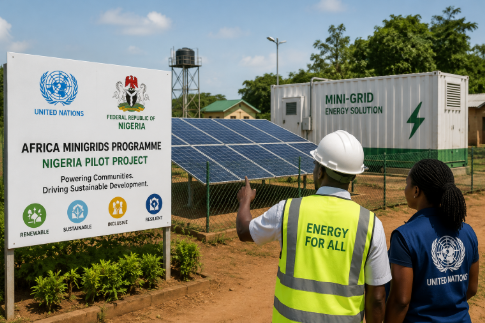
Nigeria and UN Deepen Partnership to Expand Renewable Energy Access Through Mini-Grids
The United Nations and the Nigerian government have reinforced their commitment to accelerating renewable energy deployment through decentralised power solutions, with mini-grids positioned as a critical enabler of industrial growth and socio-economic development across Africa.
Speaking at the launch of the Nigeria pilot phase of the Africa Minigrids Programme in Abuja, United Nations Humanitarian Coordinator in Nigeria Mohammed Fall emphasised that Africa’s energy transition agenda extends well beyond climate objectives and is intrinsically linked to economic transformation.
According to Fall, expanding access to renewable energy presents an opportunity to drive industrialisation, create employment and stimulate inclusive economic growth, particularly for women and young people. He highlighted Nigeria’s strong potential to emerge as a continental leader in the energy transition, citing the country’s extensive renewable energy resources, growing private sector participation and significant market opportunities.
“The energy transition in Africa is fundamentally a development agenda,” Fall said, noting that decentralised renewable energy systems are increasingly recognised as catalysts for economic activity and improved livelihoods.
He described the Africa Minigrids Programme as a demonstration of the broader developmental impact of distributed energy infrastructure. Beyond electricity provision, mini-grids support critical services and productive uses of energy, powering healthcare facilities, educational institutions, agricultural operations and small businesses while strengthening rural economies.
Fall also acknowledged the role of collaboration between government agencies, development institutions, private sector investors, technical partners and local communities in advancing the programme.
Nigeria’s Minister of Power, Joseph Tegbe, reiterated the strategic importance of mini-grids in addressing the country’s persistent electricity access challenges, particularly in underserved and rural communities.
He noted that reliable electricity supply remains a key driver of economic development, underpinning growth across sectors including agriculture, healthcare, education, commerce, digital services and manufacturing. For many rural communities, access to electricity is closely linked to business development, service delivery and employment opportunities.
Tegbe affirmed that rural electrification will remain a central pillar of Nigeria’s energy policy agenda, with decentralised renewable energy systems continuing to play a vital role in expanding access.
Meanwhile, United Nations Under-Secretary-General and Special Adviser on Africa Ahunna Eziakonwa called for accelerated deployment of renewable energy infrastructure across Nigeria. She argued that the country is well positioned to leverage growing international climate and energy finance flows to scale up electrification efforts.
Eziakonwa added that Nigeria has already demonstrated significant implementation capacity through existing renewable energy investments, creating a strong foundation for further expansion of distributed energy systems nationwide.