
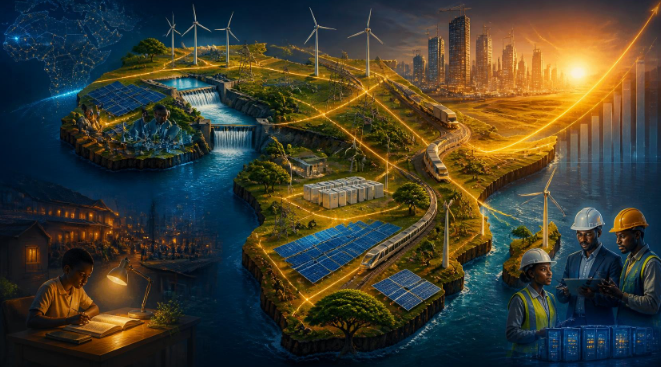
Infrastructure Investment Emerges as Key to Africa’s Energy Future, Forvis Mazars Report Finds
Africa’s ability to translate its vast energy resources into industrial growth, energy security and a lower-carbon economy will depend heavily on infrastructure investment, according to a new report by Forvis Mazars.
Released on 12 October 2026, Powering Africa’s Future 2026: Infrastructure, Energy Security and the Energy Transition in Africa examines the structural challenges and emerging opportunities shaping the continent’s energy markets. Drawing on insights from Forvis Mazars’ African offices, the report assesses the role of infrastructure in unlocking investment, strengthening domestic value chains and expanding access to reliable energy.
The findings point to a fundamental shift in Africa’s energy development priorities: moving beyond resource extraction towards integrated energy systems that support industrialisation and retain more economic value within the continent.
Africa’s expanding population and energy demand present a significant growth opportunity. The report estimates that the continent, with approximately 1.49 billion people, recorded 991 TWh of electricity generation and 82.4 GW of installed renewable energy capacity in 2025. However, inadequate transmission networks, limited regional interconnections and gaps in pipelines, refining, storage and port infrastructure continue to constrain the sector’s potential.
Uhabia Ojike, Country Leader at Forvis Mazars in Nigeria and Regional Lead for Energy and Infrastructure, said the priority was to develop infrastructure at scale rather than pursue isolated projects.
“Resources create potential, but infrastructure delivery turns that potential into economic value,” Ojike said, highlighting the importance of integrated energy systems in supporting Africa’s transition.
The report also identifies domestic value addition as an increasingly important driver of investment across the oil and gas sector. Emerging production centres in Senegal, Côte d’Ivoire, Namibia and Uganda are reshaping the continent’s upstream landscape, while major refining investments, particularly Nigeria’s Dangote refinery, demonstrate the potential to strengthen domestic processing capacity.
For producing countries, the strategic focus is increasingly extending beyond higher output to include refining, petrochemicals, logistics and local content development. These activities could deepen industrial capacity, create jobs and reduce dependence on imported refined products, provided supporting infrastructure and investment are in place.
Renewable energy is also gaining ground. According to the report, renewable sources accounted for approximately 27.5% of Africa’s electricity generation in 2025, with solar and wind among the fastest-growing technologies. Scaling their contribution will require further investment in transmission, grid connectivity and systems capable of integrating variable renewable generation.
“Africa has the energy resources to power its next phase of economic development. The challenge is turning those resources into reliable, affordable and accessible energy,” said Ibra Ndiaye, Partner at Forvis Mazars in Senegal and Regional Lead for Oil and Gas.
The report further highlights critical minerals as a potential foundation for new industrial value chains. Resources including cobalt, copper, lithium, graphite and manganese could support battery manufacturing, mineral processing and related technologies if investment extends beyond extraction into domestic refining and manufacturing.
For investors, policymakers and energy companies, the report’s central message is clear: Africa’s energy opportunity will depend not only on the resources it possesses, but also on its capacity to finance, build and connect the infrastructure required to turn them into lasting economic value.
The study also identifies critical minerals as an opportunity to move beyond resource extraction. This means Africa’s cobalt, copper, lithium, graphite and manganese resources could support new industrial value chains if investment expands into processing, refining, battery manufacturing and related technologies.