
India Becomes Third-Largest Global Renewable Energy Market
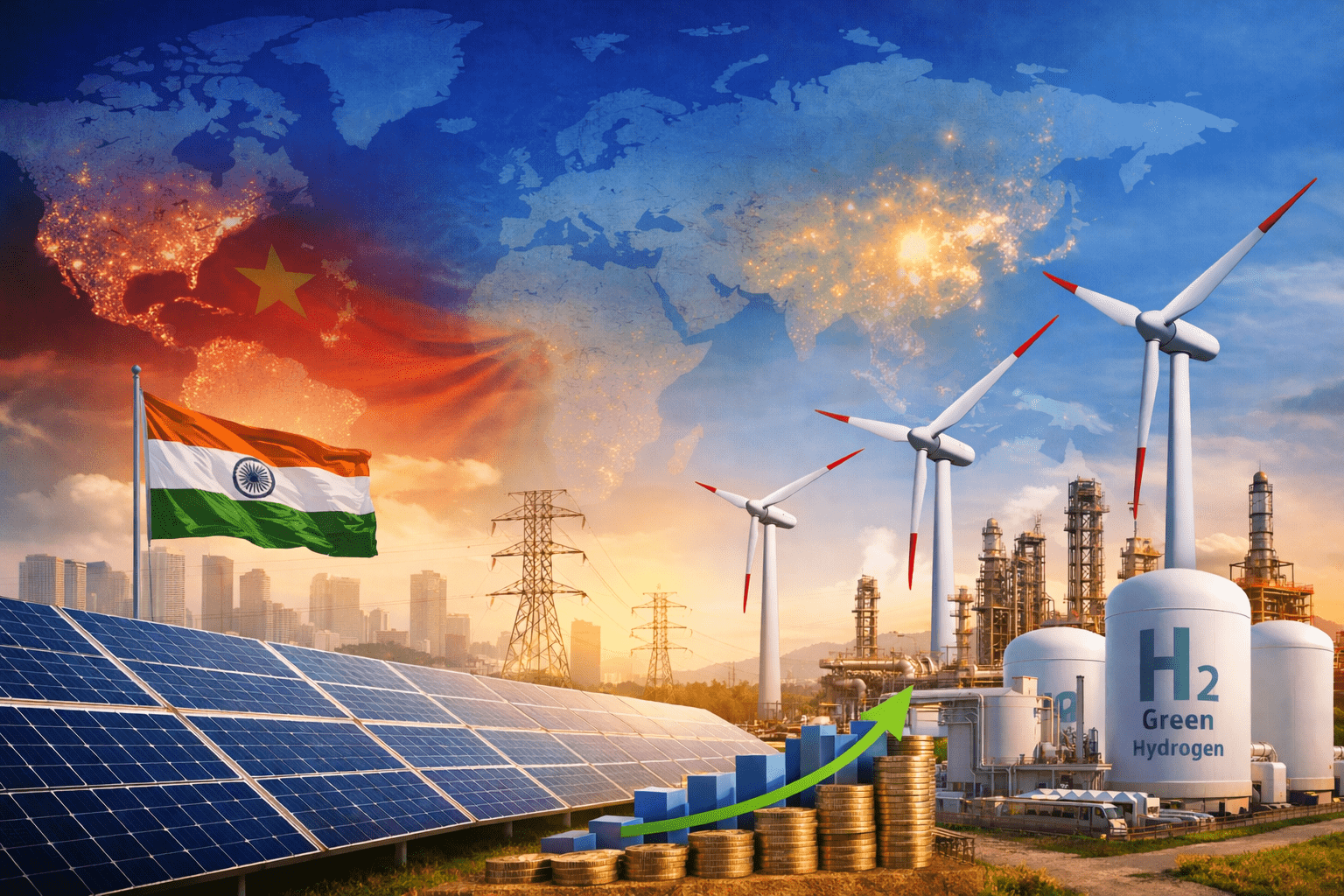
India has strengthened its position as a global clean energy leader, overtaking Brazil to become the world’s third-largest holder of renewable energy capacity, Union Minister Pralhad Joshi has confirmed.
Citing Renewable Energy Statistics 2026 from the International Renewable Energy Agency (IRENA), India now ranks behind China and the United States in total installed renewable capacity — a reflection of rapid system-scale transformation.
As of the 31st of March 2026, India’s non-fossil fuel capacity stood at 283.46 GW, including 274.68 GW from renewable sources and the remainder from nuclear energy. The country added a record 55.3 GW of non-fossil capacity in the Financial Year (FY) 2025-26, nearly doubling the previous year’s expansion.
A major milestone was achieved in June 2025 when non-fossil sources accounted for 50% of total installed capacity, reaching the country’s 2030 Paris Agreement target five years early.
In July 2025, renewable energy met 51.5% of the country’s peak electricity demand of 203 GW, highlighting its growing system reliability. Renewables contributed 26.2% of electricity generation, while non-fossil sources accounted for 29.2%. Total generation reached 1,845.9 billion units.
Solar energy remains the dominant growth driver, with installed capacity rising to 150.26 GW, over 50 times higher than in 2014. The sector added a record 44.61 GW in the period 2025–26, driven by utility-scale projects and rooftop deployment under schemes such as PM KUSUM. Wind capacity also expanded to 56.09 GW, with a record 6.05 GW added in a single year.
India’s domestic manufacturing base has expanded significantly. Solar module capacity has grown from 2.3 GW in 2014 to around 172 GW in 2026, while wind manufacturing capacity has reached 24 GW, supported by fiscal incentives and policy support.
Reforms introduced by the Ministry of New and Renewable Energy include reduced GST on equipment, the Renewable Energy Equipment Import Monitoring System, Virtual Power Purchase Agreements, Contracts for Difference pilots, and a National Policy on Geothermal Energy. Regulatory improvements by the Central Electricity Regulatory Commission have strengthened grid integration and transmission efficiency.
The National Green Hydrogen Mission, with an outlay of approximately US$ 2.38 billion, targets 5 million tonnes of annual production by 2030 and is expected to attract over roughly US$ 96 billion in investment.
India is also expanding transmission infrastructure through the Green Energy Corridor and developing renewable energy zones with 345 GW potential. Over 124,000 workers were trained in FY 2025–26 to support sector growth.
India remains on track for 500 GW of non-fossil capacity by 2030, though challenges remain around grid integration, storage, and supply chains.