IFC Injects $40m Into Africa’s Off-Grid Solar Expansion
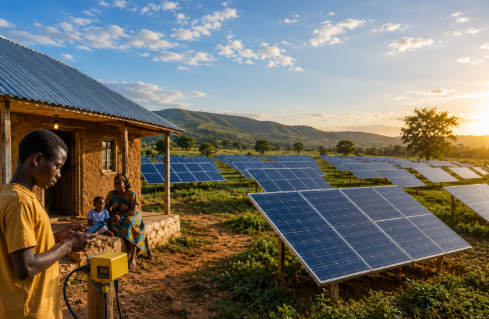
The International Finance Corporation (IFC), the private-sector investment arm of the World Bank Group, is deepening its commitment to Africa’s decentralised energy market through a $40 million convertible loan agreement with EDF Power Solutions to accelerate the rollout of off-grid solar systems across the continent.
The financing package, announced by IFC Vice President for Africa Ethiopis Tafara, combines IFC capital with private-sector co-investment to expand pay-as-you-go solar infrastructure targeting households and small enterprises in underserved markets. The move reflects growing confidence among development financiers that decentralised renewables will play a central role in addressing Africa’s persistent electricity deficit.
The investment is expected to strengthen electricity access in rural regions where grid expansion remains economically and logistically constrained. Across much of sub-Saharan Africa, unreliable or non-existent power supply continues to limit industrial productivity, business development and broader economic growth.
The agreement also supports Mission 300, the flagship electrification initiative launched by the World Bank and the African Development Bank, which aims to connect 300 million Africans to electricity by the end of the decade.
Pay-as-you-go solar has emerged as one of the fastest-scaling energy models on the continent, enabling consumers to access solar home systems through incremental mobile-enabled payments rather than high upfront capital costs. The model has gained traction, particularly among low-income households and informal businesses operating beyond the reach of national transmission networks.
Despite increasing investment activity, Africa’s energy access challenge remains substantial. Estimates from the African Development Bank indicate that close to 600 million people were still living without electricity access in 2025, with the majority concentrated in sub-Saharan Africa.
The scale of the deficit has intensified momentum behind decentralised energy solutions, including mini-grids, solar home systems and privately financed independent power projects, as governments contend with ageing infrastructure, constrained public finances and rapidly rising demand.
Development finance institutions and international lenders have steadily increased their exposure to Africa’s renewable energy sector amid mounting pressure to improve energy security and support lower-carbon growth pathways. Urbanisation, industrial expansion and rising electricity consumption are expected to drive further capital flows into the sector over the coming decade.
Mission 300 has already emerged as one of the continent’s largest energy access platforms. A progress update released late last year showed the programme had mobilised more than $8.5 billion in commitments and secured energy partnership agreements with 17 African states.
The EDF transaction forms part of IFC’s wider strategy to scale private investment into African clean energy infrastructure. Earlier this week, the institution also announced plans to commit up to $40 million in equity financing to the Facility for Energy Inclusion, a pan-African clean energy investment platform managed by Cygnum Capital.
The fund backs decentralised power projects, including mini-grids, solar home systems and small-scale independent producers, and is projected to expand assets under management to approximately $750 million following the latest capital injection.
Industry analysts say sustained private-sector participation will be essential if African economies are to narrow the electricity access gap, improve grid resilience and support long-term industrial and commercial growth.