Egypt Accelerates Debt Repayment to Drive New Energy Investment
Egypt is moving decisively to restore momentum across its upstream oil and gas industry, with the government sharply reducing outstanding payments owed to international oil companies and bringing forward its debt clearance timetable in a move expected to strengthen investor confidence and unlock new capital.
Speaking on Monday, Oil and Mineral Resources Minister Karim Badawi confirmed that Egypt now intends to settle all remaining arrears to foreign energy partners by 10 June, nearly three weeks ahead of the government’s previously announced end-of-month target.
The revised timeline marks a notable shift in Egypt’s energy investment outlook. After a prolonged period of economic pressure, foreign currency shortages and delayed payments that weighed heavily on operational activity, the government is positioning the sector for renewed growth and faster project execution.
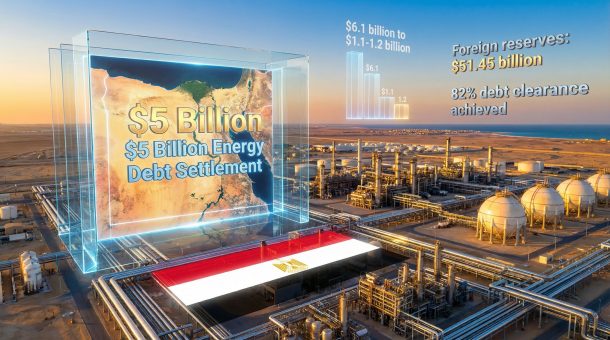
Outstanding payments to international oil companies have fallen dramatically, from US$6.1 billion in June 2024 to roughly US$440 million as of May 2026, one of the clearest signs yet of Egypt’s broader effort to stabilise the operating environment for international investors.
The development is being closely monitored across the Eastern Mediterranean, where Egypt remains a strategically important producer and export hub. Government officials say the repayment programme is already translating into stronger field activity, with several international operators accelerating exploration and development plans.
Projects led by major global players, including Shell, BP, Eni, Chevron, ExxonMobil and Archeos are understood to be gaining momentum, particularly offshore in the Mediterranean, where development timelines are being revisited as payment concerns begin to ease.
For much of the past several years, delayed reimbursements created uncertainty for foreign operators and became a persistent pressure point in Egypt’s relationship with international investors. In several cases, companies slowed planned capital deployment and reduced activity while awaiting payment certainty and improved access to hard currency.
Those pressures intensified between 2023 and 2024 as global inflation, tighter financial conditions and the wider economic fallout from the war in Ukraine placed further strain on Egypt’s economy.
Since 2025, however, Egypt’s hydrocarbons sector has begun to recover. Exploration activity has increased, investor sentiment has strengthened, and authorities have stepped up efforts to reinforce domestic supply and improve long-term energy security.
By moving ahead of schedule on debt repayment, Cairo is sending a stronger message to upstream investors: Egypt intends to remain a dependable investment destination and preserve its role as one of the Eastern Mediterranean’s leading energy and gas infrastructure hubs.