
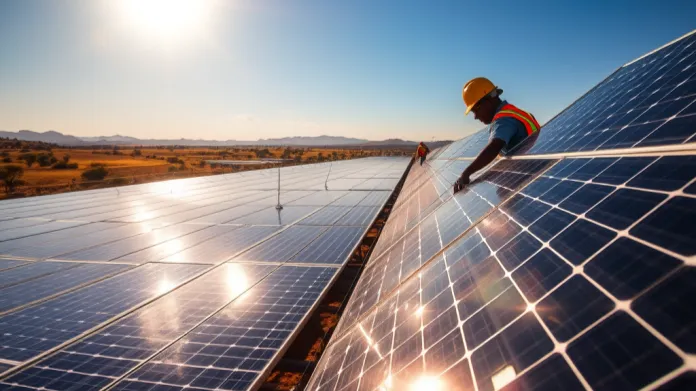
Africa’s Solar Manufacturing Push Gathers Pace
Africa’s solar industry is beginning to move beyond its role as a major importer of photovoltaic equipment, with panel manufacturing capacity expected to reach 3.5 GW this year.
The expansion, highlighted in a report by Ember and Africa Tech Futures Lab, marks a significant increase in the continent’s ability to manufacture finished solar panels. Egypt is expected to account for the largest share, with 2 GW of new capacity, while Tanzania is set to add a further 500 MW. Morocco, South Africa, Algeria, Tunisia, Nigeria, and Kenya are collectively expected to contribute an additional 1 GW.
The increase comes against a backdrop of heavy dependence on Chinese solar supply chains. Up to 94% of solar panels installed across Africa are currently imported from China. Between January 2024 and June 2026, the continent imported around 19 GW of PV cells and 9 GW of wafers, while producing just 2.7 GW of finished panels.
For project developers and EPC contractors, the emergence of local manufacturing could strengthen supply-chain resilience, but cost remains a formidable challenge. Chinese panels continue to benefit from substantial economies of scale, with some products reportedly selling for around $80 per unit.
The commercial viability of African-made panels will therefore depend not simply on increasing production capacity, but on whether manufacturers can compete on price, quality, reliability and access to finance.
Trade policy could prove decisive. A significant portion of the new production capacity in Egypt and Tanzania is reportedly targeting the US market, where panel prices remain comparatively attractive. However, potential changes to US tariffs in December could alter that equation.
If exporting to the US becomes less commercially attractive, manufacturers could increasingly turn towards African markets. That could create an opportunity to shorten supply chains, develop local industrial capacity and retain more value within the continent’s rapidly expanding solar sector.
For Africa’s energy industry, the significance of the manufacturing build-out extends beyond panels. A stronger domestic supply base could support the development of a broader renewable-energy value chain, provided production can scale without compromising project economics.