
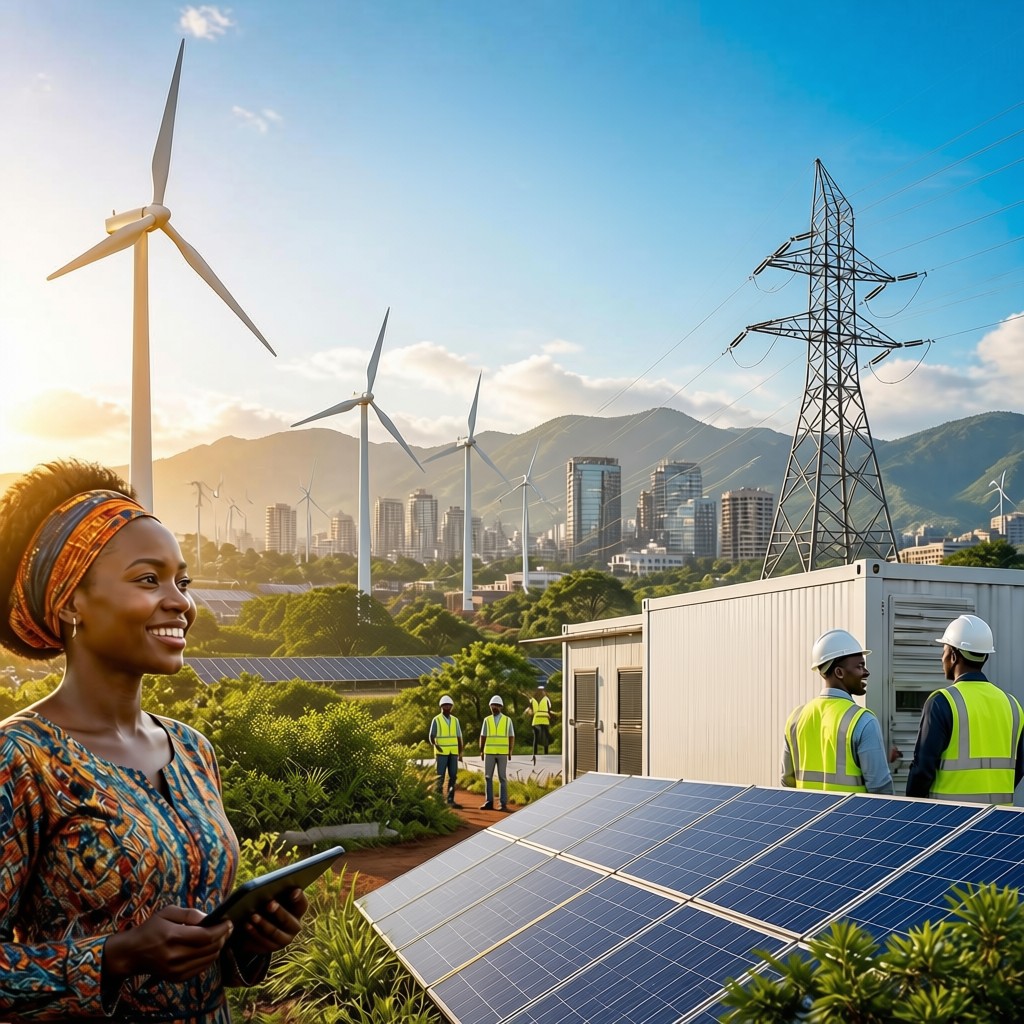
Africa’s Grid Challenge: Can Transmission Keep Pace?
Africa’s energy transition is gathering momentum, with governments and developers expanding solar, wind, hydro and other generation projects. Yet a critical weakness threatens to undermine this progress: transmission infrastructure is struggling to keep pace with new generation and rising electricity demand.
Grid Expansion in Action: Lessons from Africa
Across the continent, ageing networks, limited transmission capacity and inadequate regional interconnections continue to constrain electricity delivery. The challenge is particularly significant as Africa seeks to close a major energy access gap, with more than 600 million people still without electricity.
South Africa provides a clear example of the scale of the challenge. The country is planning a major expansion of its transmission network, with plans for approximately 14,500 kilometres of new transmission lines and 133,000 MVA of transformer capacity by 2034. The investment reflects growing pressure on the grid as new generation projects come online and demand increases.
Elsewhere, regional interconnection is demonstrating how stronger transmission networks could support Africa’s energy future.
The Ethiopia–Kenya electricity interconnector, commissioned in 2023, enables electricity trade between the two countries and has a capacity for bidirectional transfers of up to 2,000 MW. The project is part of wider efforts to strengthen electricity integration across East Africa.
Regional power pools are similarly seeking to improve cross-border electricity trade. The Eastern Africa Power Pool brings together 13 countries, while the West African Power Pool is developing interconnected networks to facilitate regional electricity exchanges and improve supply reliability.
Building the Grid Will Require More Than Infrastructure
However, expanding Africa’s transmission infrastructure will require more than new power lines. Governments and utilities face challenges around financing, regulation, procurement, project development and cross-border coordination.
Digital technologies could also play an increasingly important role. Smart-grid solutions, advanced monitoring, automated controls and improved forecasting can help utilities optimise existing networks, improve reliability and integrate growing volumes of variable renewable energy.
Africa’s Energy Future Depends on Moving Power
As Africa adds generation capacity, the question is no longer simply how much electricity the continent can produce. It is whether the grid can move that power to where it is needed.
This will be a central question at “Africa’s Grid Challenge: The Missing Link in the Energy Transition” Webinar, where industry experts will examine the transmission bottlenecks that are limiting energy growth, strategies for accelerating grid development, the role of smart-grid technologies, and transmission projects that could provide models for other African markets.
Join the conversation on 15 October 2026 as industry leaders explore what it will take to build the grid that Africa’s energy future demands.