Germany Advances Green Hydrogen Projects in Chile and Ghana
Germany is strengthening its international green hydrogen footprint through two pilot projects in Chile and Ghana, targeting decentralised energy supply, energy storage and fuel cell applications.
H2Datacenter, launched on 1 October 2026 in Chile, and H2Scale, introduced in Ghana on 1 November, are funded under Germany’s Export Initiative Environmental Protection (EXI), led by the Federal Ministry for the Environment, Climate Action, Nature Conservation and Nuclear Safety (BMUKN).
The projects form part of EXI’s programme supporting green hydrogen and fuel cell technologies for decentralised energy systems.
According to Nilgün Parker, Head of the GII3 division at BMUKN, the initiatives will explore hydrogen’s potential in powering data centres while developing standardised power-to-power systems adapted to African markets.
Chile explores hydrogen-powered data centres
In Chile, H2Datacenter will investigate how green hydrogen can provide reliable, low-carbon electricity for data centre operations. Led by Germany’s Reiner Lemoine Institute (RLI) and H2 Powercell GmbH, the pilot will be implemented at a site operated by Patagonian company Datco.
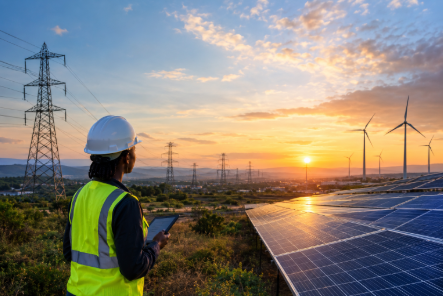
The system will combine solar photovoltaic generation, an electrolyser, hydrogen storage and a fuel cell. Excess solar electricity will produce green hydrogen, which can be converted back into electricity when required. The solution will be tested for emergency power supply and additional energy storage, addressing the growing demand for reliable electricity as digital infrastructure expands.
Ghana targets scalable hydrogen solutions
Meanwhile, H2Scale will focus on developing a standardised, modular and relocatable power-to-power system housed in a container. The project builds on GH2GH, an earlier EXI-funded initiative implemented between 2023 and 2026.
Bochum University of Applied Sciences, Green Power Brains GmbH, SFC Energy AG and Ostermeier H2ydrogen Solutions GmbH are collaborating to develop a solution that can be replicated across different decentralised energy applications in Ghana and sub-Saharan Africa.
The initiative aims to demonstrate how modular hydrogen systems can support decentralised electricity supply while exploring cost reductions and commercially viable business models. NOW GmbH CEO Dagmar Fehler said the projects would advance sustainable energy technologies while generating practical experience in scaling decentralised hydrogen solutions.
Expanding international hydrogen deployment
Established in 2016, Germany’s EXI programme supports small and medium-sized German environmental technology companies in introducing innovative solutions to international markets.
For African energy markets, H2Scale presents an opportunity to assess the technical and commercial viability of modular hydrogen systems. Its success could help establish replicable solutions for decentralised power generation and strengthen the adoption of German hydrogen technologies across the region.